
Den nye publikation Virksomheder der gør en forskel - Socialøkonomiske virskomheder i Aarhus præsenterer 20…
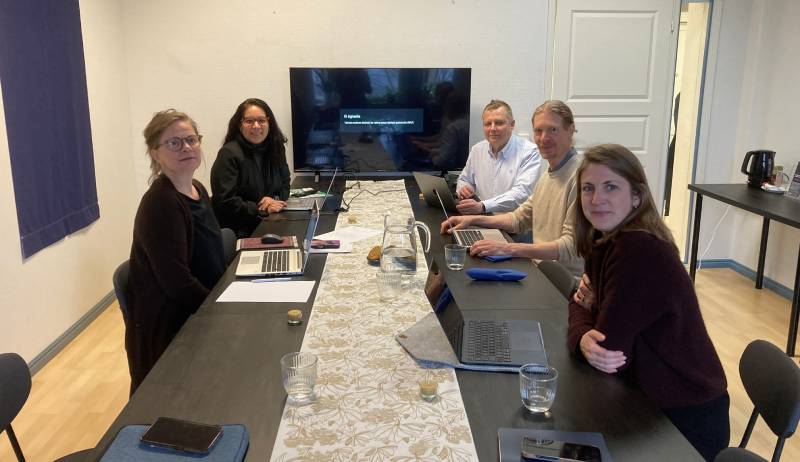
Report from the Nordic Social Enterprise Network Partner Meeting in Helsinki April 22-24
Social Entrepreneurs in Denmark (SED) participated in a Scandinavian partner meeting in Helsinki on April 23-24, 2025. The meeting, which was part of the Erasmus+ Adult education mobility programme – invited experts, allows organizations to invite experts from other countries to share their knowledge in different areas, in this case social economy enterprises. The programme also allows organizations to exchange and learn from the experiences of other countries.
The meeting was also a rare opportunity to gain insight into the state of social enterprises in the other Nordic countries and the challenges they are facing. The Nordic countries have a great deal in common — including the challenges they encounter.
They are all built around the same welfare model, which is currently under pressure across the Nordic region. The social enterprise model offers many different solutions within the welfare sector and for the people in our societies who are most in need of support. In this way, they can also play an important role in alleviating the pressure on the welfare system.
The meeting was therefore also part of the groundwork for establishing a Nordic Network for Social Enterprises, where we can strengthen knowledge sharing and collaboration across the Nordic field — a partnership we see great potential in and are very much looking forward to.
In addition to SED, representatives from SE Forum Sweden (Tove Nordström), Charge, Norway (Suzana Meza) and Valo-Valmennusyhdistys/ Silta-Valmennusyhdistys ry (commonly known as Silta/Valo) from Finland hosted the meeting.
Silta and Valo are social economy enterprises and both have played a key role in promoting social economy enterprises in Finland and have also been among the main forces in drafting the social enterprise strategy published in 2021 by the Finnish Ministry of Economic Affairs and Employment.
Both are also among the 11 Finnish organizations that co-lead the National Competence Center for Social Economy Enterprises “Center of Expertise for Social Enterprises” (YYO). The center is placed under the Ministry of Economic Affairs and Employment and the establishment of the center was part of the national strategy for social economy enterprises.
The 11 organizations consist of social economy enterprises, public expert institutions (Finnish Institute for Health and Welfare) and universities.
The National Competence Center for Social Economy Enterprises has received 15 million euros in funding until 2027. As this is EU funding, there is the mandatory 20% co-financing.
The overall theme of the meeting was how to strengthen the Nordic field of social economy enterprises and its supporting organizations.
Day 1 of the meeting was primarily spent with the different organizations giving a presentation of their own work and the status of social economy enterprises in their respective home countries.
Charge, Norway
Susanna Meza from Norway talked about Charge
Charge is a Norwegian organization based in Oslo that works to promote entrepreneurship among international and underrepresented entrepreneurs and runs various programs for these groups.
The organization’s mission is to create an inclusive platform where entrepreneurs can develop and scale their businesses both in Norway and internationally.
Charge offers several programs designed to support entrepreneurs at different stages:
Changemaker: A five-month incubation program for early-stage entrepreneurs where participants are helped to explore, test and validate their business ideas.
LEAP: A fundraising program for startups with at least one underrepresented founder, such as women, immigrants or people with disabilities.
BSR Go-Abroad: A free online program that helps small and medium-sized businesses in the Baltic Sea region scale and engage in international activities.
In addition, Charge runs initiatives such as NordConnect and Charge Future, which focus on strengthening entrepreneurship and innovation in different regions and sectors.
The organization is supported by various program and funding partners and works closely with local and international actors to create a supportive ecosystem for entrepreneurs. Through their work, Charge aims to help promote diversity and innovation in the Norwegian business community.
More about Charge here
Susanna mentioned that securing stable long-term funding for the organization is an ongoing challenge. Like Silta-Valo, Charge has also considered the company form in relation to funding. Right now, Charge’s organization as a company can be a challenge in terms of funding. Foundations understand more easily when an association or non-profit organization seeks funding for initiatives for underrepresented groups with challenges, and many foundations can, due to their statutes, have challenges with having to donate funds to a COMPANY.
Susanna also mentioned that it is important for Charge to scale in the future. According to her, it’s important that the organization has a certain size and a supporting number of employees in order to be heard and taken seriously by politicians and companies.
In Norway, not much political attention is paid to social enterprises. There is no strategy for the area and social enterprises have hardly been part of any political initiatives in recent years According to the report Social Enterprises and Their Ecosystems in Europe – Norway from 2018, there are 115 social enterprises
Most funding opportunities are short-term project funding of, say, two years. So funding for social enterprises can be difficult. Several organizations have cut back on activities, for example in Oslo.
As mentioned, funding is an ongoing challenge. Most funding opportunities are short-term project funds of e.g. two years. So creating long-term funding for your work can be difficult for social economy companies working with social initiatives. Funding for civil society and social enterprises has also decreased in recent years, as is the case in other Nordic countries. For example, several organizations have cut back on activities in Oslo.
However, there are still several organizations in the Norwegian ecosystem for social economy businesses and social entrepreneurship, such as the large family-owned company Ferd, which invests in social entrepreneurs and also host an annual competition for Social Entrepreneur of the Year.
SE Forum – Sweden
Tove Nordström from Sweden then spoke about SE Forum (Social Entrepreneurship Forum) and the status of social enterprises in Sweden.
SE Forum is a Swedish non-profit organization that since 2004 has worked to promote social entrepreneurship and innovation as a driving force for positive social change. Based in Stockholm, they act as a platform that connects actors across sectors to solve social and environmental challenges.
Activities and support
SE Forum offers programs such as accelerators, workshops and training that support social entrepreneurs in Sweden and internationally. Among their initiatives are the SE Outreach Accelerator, GATHER Fellowship and Care of Business Impact Accelerator.
Projects and collaborations
Through projects such as “Samhällsentreprenörskap Sverige 2.0” and the establishment of a regional platform in Södertörn, SE Forum works to strengthen the ecosystem for social innovation. They collaborate with partners such as Södertörn University, Impact Invest and Fabege.
Knowledge and networks
SE Forum disseminates knowledge and inspiration about social entrepreneurship through research and events and collaborates with actors such as Ashoka Nordic, Reach for Change and Mikrofonden. They bridge sectors to create sustainable solutions locally and globally.
For more about SE Forum here
Sweden has had a strategy for social economy enterprises from 2018-2020. But since then, there has been very little political interest in social economy enterprises. In fact, the strategy is no longer available on the government website.
It’s difficult for social economy enterprises and support organizations to get funding. There has been a small amount of funding from the European Social Fund (ESF) for the Swedish EU Competence Center for Social Innovation. However, SE Forum and four other partners have had to share SEK 9 million over a three-year period, which has limited opportunities for activities.
The Swedish government has also not actively taken the initiative to work on implementing the EU Council Recommendation on Social Economy or the Social Economy Action Plan.
Sociale Entreprenører i Danmark – Denmark
Finally, Per Bach from Social Entrepreneurs in Denmark talked about the status of the social economy in Denmark.
Since 2010, Social Entrepreneurs in Denmark has worked to promote social entrepreneurship nationally and internationally by disseminating knowledge, organizing events, participating in national and international projects, collecting data and verifying social economy businesses.
More about Social Entrepreneurs in Denmark here
In Denmark, national political interest in social economy enterprises and their potential is very low, as is the case in Norway and Sweden.
The latest national strategy for the area is from 2014-2015, and since 2015, when the national Growth Center for the Center for Social Economy Enterprises closed, there have been no national political activities for the area, apart from a few pools targeted at the area.
The Danish government has allocated DKK 22 million (2.9 million euros) in the period 2023-2026 for the development of democratic enterprises, which could be, for example, cooperative enterprises. In the EU Council Recommendation (page 26), democratically owned or managed enterprises are mentioned in the definition of social economy organizations.
In addition, the Danish government has not worked actively to implement the EU Council Recommendation on Social Economy or the Social Economy Action Plan.
In Denmark, since 2015, social economy enterprises have had the opportunity to be registered as a “registered social economy enterprise” and have thus been able to use the RSV label in marketing themselves. This is not a business form but a legal status. And there are no immediate benefits associated with registration. However, SED encourages social economy enterprises to register in order to help create greater visibility for the area and to maintain a certain political attention to the area.
The law behind the scheme was passed by the Danish parliament in 2014. Approximately 1000 companies have registered since then. However, as there is a lack of supervision of the scheme, it is SED’s assessment that many of these are unfortunately incorrectly registered.
Day 2
After a brief recap of day 1, day 2 started with Eeva Salmi talking about Silta and Valo. Both organizations work with vulnerable groups of people, including young people, who are involved in the justice system, with a commitment to making them more visible in society and giving them the opportunity to be heard at all levels of decision-making.
Silta is an old organization founded in the early 1900s, and has previously operated primarily in the Tampara area. The organization currently has 120 employees. Valo was founded in 2017 as a national organization and thus has activities in several locations in Finland and is also engaged in international projects. The organization currently has 130 employees. The two organizations have the same director, and even though they are two independent organizations, their work is merged in many ways.
Eeva explained that the organization has had many considerations in relation to which business form to choose for the organization, as it can have consequences in terms of funding opportunities and in relation to attracting partners.
Both organizations work with the most vulnerable people in Finland – for example, people with criminal backgrounds, alcoholics, vulnerable youth and disabled people.
Silta and Valo offer a variety of services to these people, such as rehabilitation, education, employment, hobby services, housing services, immigrant and language services, accreditation of competences and worklife coaching.
The range of services that can be offered in the different regions of Finland is determined by what the organization can raise funding for legally.
Eva explained that it can be difficult to find the target group for Silta and Valo’s work. It can be people who sit at home for years and can be hard to locate.
That’s why Silta-Valo does outreach work at street level and via social media to reach the target group. But overall, it can be difficult to find the people who really need the services that the organizations offer. Funding
Silta-Valo derives 57% of its income from tenders and 43% from donations from a number of foundations, public funds and programs such as EU funding ESF, Erasmus+ etc.
Funding is a constant exercise in getting a patchwork of funding sources to ensure that the organization’s efforts can be maintained in the best possible way.
Fremtiden
Den primære arbejde for Silta-Valo er, både nu og fremadrettet, at forstå de måder hvorpå man kan lave samfundet mere inklusivt, og hvordan man bedst kan støtte de mennesker, der er ekskluderede så de kan intergres i samfundet.
Silta-Valo ønsker ikke primært at skalere i størrelse, men organisationerne vil gerne skalere i impact. Det betyder f.eks. at hvis en god service for organisationens målgrupen tilbydes af andre og på den måde allerede eksistere i et område af landet er der ikke ikke grund til også at skalere Silta-Vallo´s aktiviteter til dette område.
More on Silta here
More on Valo here
Currently, the work of social economy enterprises in Finland is secure because the National Competence Center YYO has funding until 2027, but after that nothing is certain. Therefore, a major task for the field’s organizations is also to work purposefully on how the center’s work can continue after 2027.
What can we do together?
Afterwards, we had a short discussion about the future of the social economy field and the support organizations in it, as well as the challenges the field faces.
Fundraising and financing is as previously mentioned one of the major challenges for the field. Per from SED mentioned Social Enterprise UK’s funding model. The organization gets about a third of its income from memberships, a third from consultancy work such as research assignments and a third from matchmaking services, where they match traditional businesses with social enterprises that they can collaborate with or that the traditional business can buy products and services from.
Another major challenge is that there is a lack of general understanding of what a social economy enterprise is and the positive impact it creates. This applies to the general public, public authorities and private companies. Here we have a major communication task in conveying the potential of social economy enterprises. This applies not least in relation to To help strengthen and preserve the Nordic welfare society.
We talked about expanding the Nordic network with 1-2 researchers from each of our respective countries. Research into social economy enterprises will be an important element in documenting the potential of social economy enterprises.
Konkrete tiltag vi vil arbejde på
-
-
- Going forward, we will work to strengthen the Nordic network by ensuring regular meetings – both online and in person.
- We will also continue to work on a common vision for the Nordic network for social economy companies.
- We will explore how we can develop common funding strategies for sustainable long-term funding.
- We will work to create more funded projects together – first smaller and then larger projects.
- We will jointly map the ecosystem for social economy businesses in the Nordic countries – Sweden, Norway, Finland, Denmark, Iceland, the Faroe Islands and Greenland
- Finally, we will also contact the Nordic Council of Ministers to see if they can assist with the development of the Nordic network for social economy enterprises.
-
Thank you to our Nordic friends for a great few days. We look forward to continued cooperation!

Related Posts


